
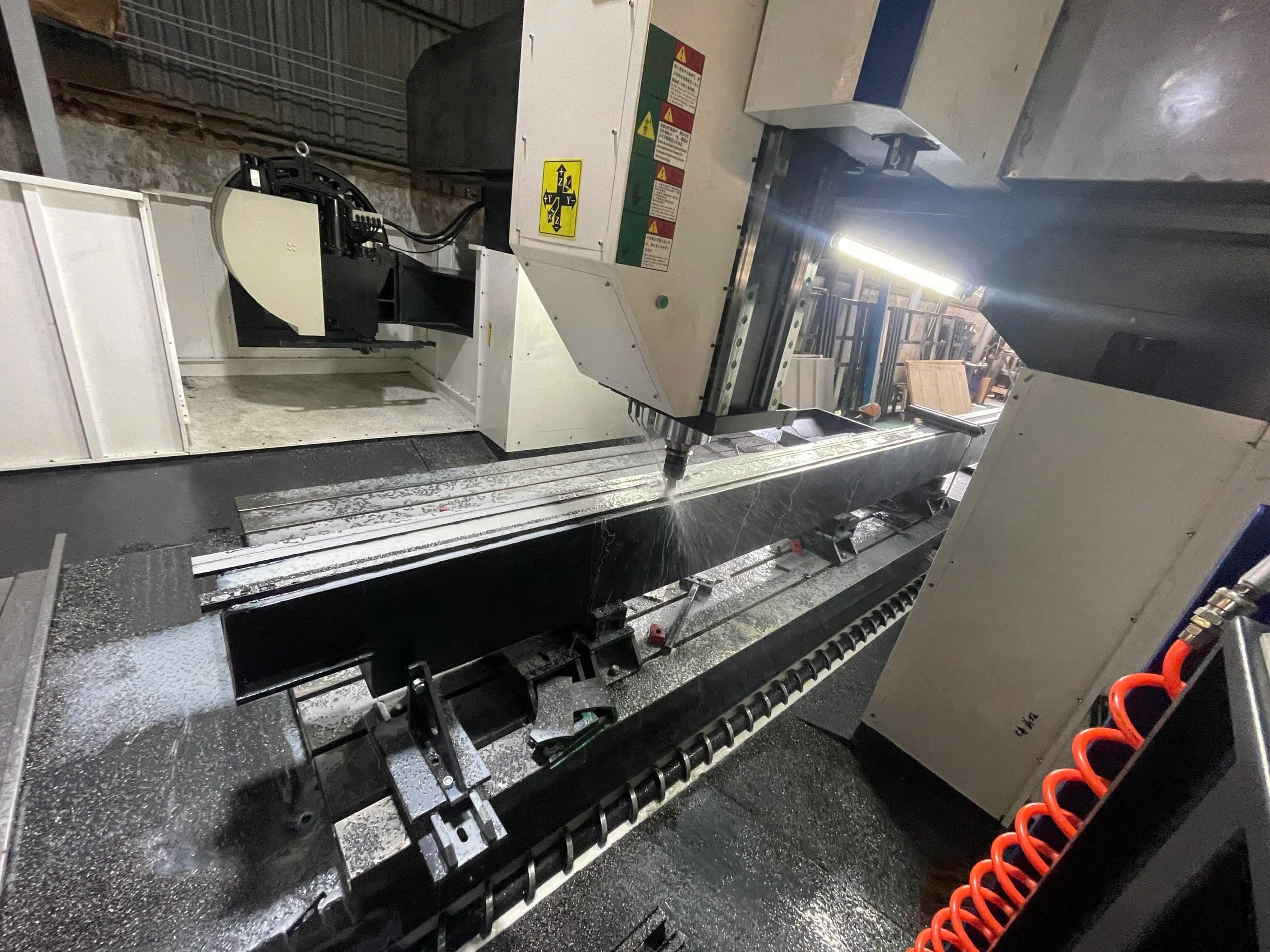
Long parts such as a 4 m bar usually distort for four reasons: residual stress in the stock is released by cutting, machining generates heat, clamping forces the stock against the table, and the stock sags between supports. The remedy is to choose stock in the right condition, support it closely, clamp without forcing it, cut evenly from both faces and measure again after releasing the clamps. This article walks through each step of large-format CNC milling, with a few figures you can calculate yourself.
Why long parts distort
Each cause leaves a different signature, so the way a part has bent usually tells you where the problem lies.
| Cause | Signature | Remedy |
|---|---|---|
| Residual stress in rolled or welded stock | Correct while clamped, bends evenly along its length once released | Choose stress-relieved stock, cut both faces evenly, rest before the finish pass |
| Clamping force | After release, the face is warped exactly where the clamps were | Fill gaps before tightening, clamp directly over supports |
| Sag between supports | Thicker at mid-span than at the ends | Reduce support spacing, especially for thin plate |
| Heat from machining | Dimensions measured hot and after cooling disagree | Even coolant, light final pass, measure once the part has stabilised |
Choose the stock before it reaches the machine
With welded stock or heavy material removal, most distortion is already in the stock; milling only reveals it. For aluminium plate, choose a stretched, stress-relieved temper such as 6061-T651 or 7075-T651. Rolled steel plate has uneven residual stress through its thickness, so removing a lot from one face usually bends the plate.
Welded frames and bases need the most care, because welds hold high stress and milling the datum faces releases it. If the flatness requirement is tight, stress-relieve before milling. On the drawing, mark the datums and the most important faces so the shop knows which to protect.
Support spacing matters more than you think
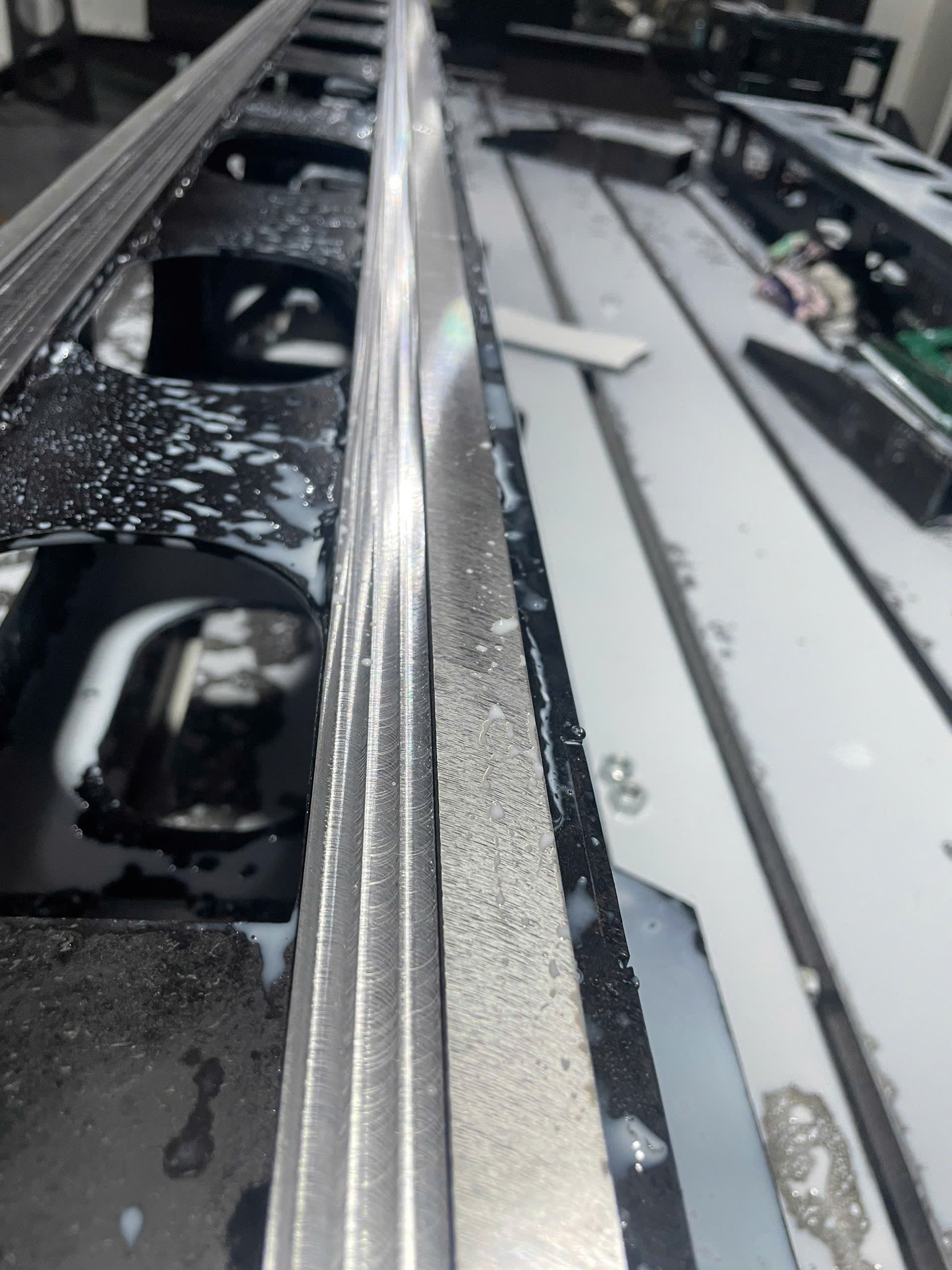
Sag from self-weight grows with the fourth power of support spacing: double the spacing and the sag rises 16 times. The table shows mid-span sag of steel plate from its own weight alone.
| Support spacing | 20 mm plate | 10 mm plate |
|---|---|---|
| 0.5 m | 0.01 mm | 0.04 mm |
| 1 m | 0.14 mm | 0.57 mm |
| 2 m | 2.3 mm | 9.2 mm |
These figures explain why a 10 mm plate supported every 2 m can hardly be milled flat by relying on clamps alone. For self-weight sag, aluminium gives almost the same result as steel, because it is about three times lighter but also about three times less stiff. Clamping and cutting forces are different: under the same force, aluminium deflects about three times more than steel.
Fixturing: clamp without forcing the stock
A common mistake is forcing bent stock flat against the table. The face looks perfect, but once released the stock springs back and takes the bend with it. A sound sequence:
1. Rest the stock on its supports without tightening anything.
2. Check the gap at each support with feeler gauges, then shim to exactly that gap instead of pressing the stock down.
3. Place clamps directly above the supports. A clamp between two supports bends the stock.
4. Tighten from the middle towards the ends, raising the force over several rounds. Mount a dial indicator near the clamp but independent of it. Clamps always move the stock slightly, but a reading that is large against the required tolerance means the clamp is bending the stock.
5. Check the length you can really use. The WP4028 gantry mill travels 4,400 mm in X, so a 4 m part leaves only 400 mm for the cutter diameter and lead-in moves, and the end clamps must stay clear of the toolpath. Simulate it in CAM before setting up.
Cutting order: remove material evenly from both faces
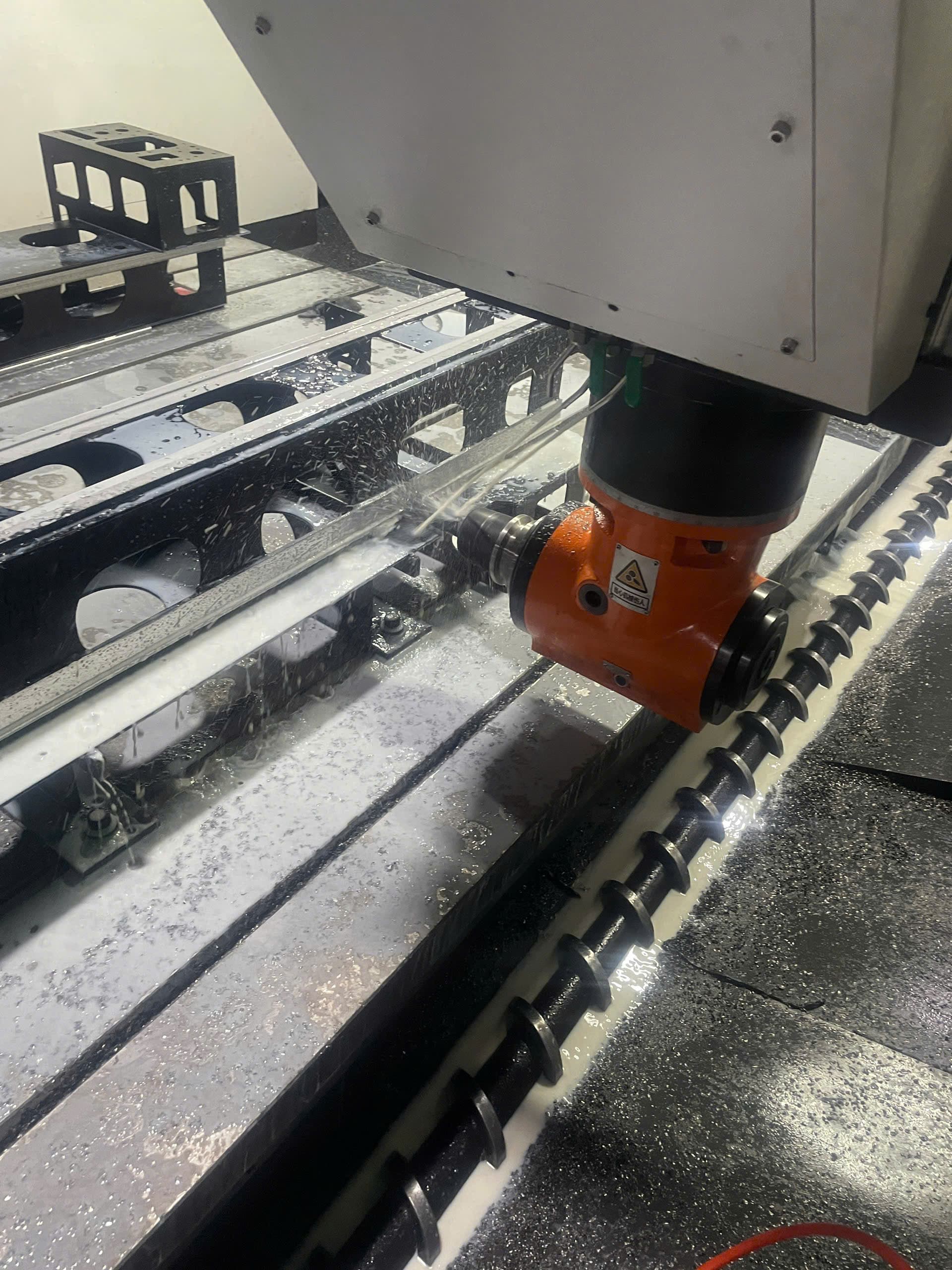
Do not finish one face before turning the part over. Rough part of each face and swap, so stress is released evenly. On parts with many pockets, cut symmetrically from the middle towards the ends rather than from one end to the other.
After roughing, release every clamp so the stock can settle into its new shape, let it rest, then shim and re-clamp with less force before finishing. Leave enough stock after roughing for semi-finishing and finishing, more for welded stock; the exact figure depends on material and thickness. Keep the final pass very light, with a sharp cutter and even coolant.
Temperature: a few degrees matter
Over long lengths, thermal expansion is no longer small. A 4 m bar that warms by 5 °C grows about 0.24 mm in steel and 0.46 mm in aluminium, enough to affect long dimensions with tight tolerances. Measuring steel with a steel scale at the same temperature mostly cancels out, but measuring aluminium with a steel scale does not. A temperature difference between faces also bends the part: a 4 m steel bar 20 mm thick with 1 °C between top and bottom bows about 1.2 mm by calculation. So measure once the part has stabilised, record the temperature, and never measure straight after a heavy cut.
How to measure properly
Measure twice: once while clamped and once after every clamp is released. The difference is the distortion the clamps were hiding. For a quick check, measure at both ends and at mid-span, at the same points each time, and record them with the temperature; accepting flatness needs a denser grid as per the drawing. When ordering, state in which condition and on which supports flatness and straightness are to be measured, because long stock on sparse supports sags under its own weight and this often causes disputes at acceptance.
When the part is longer than the machine travel
A part longer than the travel has to be re-clamped, and the hard point is the joint between the two milled sections. Before moving, machine a datum face or datum holes to re-locate from; after moving, re-indicate before cutting on, and overlap the two sections slightly. At Z Robotics, parts 8–10 m long are milled on the WP4028 with dedicated fixtures and 2–3 re-clamping moves. We have machined parts for oil & gas and shipbuilding partners; see more on our large-format CNC milling page.
Frequently asked questions
Which distorts more on a long part, aluminium or steel? — At the same size, sag from self-weight is nearly equal. But aluminium deflects about three times more than steel under the same clamping force, and expands almost twice as much with heat. Aluminium that has not been stress-relieved also warps easily when a lot of material is removed.
Must welded stock be stress-relieved before milling? — Not always, but it is advisable when flatness is tight or a lot must come off the datum faces, because welds hold high stress and the frame will change shape as it is milled.
Can a part that has bent after milling be saved? — It depends on the remaining allowance. If there is some left, release the clamps, shim to the bent shape and re-mill the datum. If not, consider cold straightening for steel or remaking the part.
What should I send for a quote on a long part? — 2D drawings or a 3D model, material and stock condition, quantity, datums, and the flatness and straightness required. For welded frames, add photos of the stock.
Have a long part to machine? Send your drawing for a quote. See also precision CNC machining and important considerations for large-format CNC milling.
Contact Z Robotics
We would be delighted to accompany you in your mechanical machining and automation projects. For consultation, please contact us:
🏢 Head office: 118/137 Phan Huy Ich Street, Tan Son Ward, Ho Chi Minh City
📍 Business location: 335 DT743B Street, Dong Tac, Di An, Ho Chi Minh City
📞 Phone: Mr. Thanh — 0973 040 871